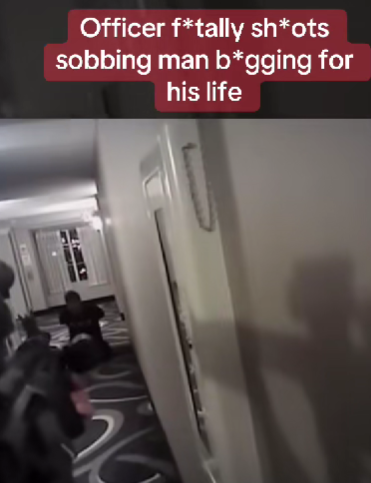
A deeply disturbing video has once again reignited the national debate over police use of force and accountability. The footage, captured from an officer’s body camera, shows a tense encounter unfolding inside a hotel hallway—an encounter that would end in tragedy for a man sobbing and b*gging for his life.
The video begins with a chilling stillness broken only by the desperate voice of a terrified man. He’s on his knees, crying and pleading with the officers not to harm him. Despite his visible compliance and panic, the situation quickly spirals out of control. Within seconds, a flurry of commands, confusion, and shouting fills the hallway—until a burst of gunfire shatters everything.
The man collapses, motionless, as officers rush forward. The silence that follows is deafening. The clip has since gone viral, sparking waves of anger, heartbreak, and disbelief across social media platforms. Many viewers describe it as one of the most harrowing police videos they’ve ever seen—one that forces them to question not only police training but the very systems meant to ensure public safety.
Civil rights advocates and community leaders are demanding full transparency. “This was not just a tragedy—it was a complete failure of humanity,” one activist said. “No one should lose their life while pleading for mercy.” Legal experts, meanwhile, note that cases like this often hinge on whether the officer’s actions were deemed “reasonable” under the circumstances, a standard that many argue too often favors law enforcement.
In cities nationwide, vigils have begun forming in memory of the victim, whose final moments—captured in haunting clarity—have now become a symbol of something larger: the urgent call for reform. The public outcry isn’t limited to one side of the political spectrum; people from all backgrounds are uniting around a shared sense of outrage and sorrow.
Police departments across the country have responded by promising additional reviews of training procedures and crisis de-escalation tactics. Some departments are implementing scenario-based exercises that emphasize communication and restraint. Others are calling for stricter oversight, insisting that accountability must be more than a buzzword—it must be a guarantee.
While the investigation into the incident continues, the emotional impact is already undeniable. It’s a heartbreaking reminder of how quickly a routine encounter can turn deadly and how fragile the line between authority and abuse can become.
As the nation watches and waits for answers, one question echoes louder than any other: how many more lives must be lost before real change is made?
This tragic hallway confrontation will undoubtedly remain etched in public memory—not only for its horror but for what it represents: the desperate need for compassion, empathy, and justice in a system where too often, those values are nowhere to be found.